
When Your Degree and Your Job Don’t Match: Why Filipino Professionals Should Dream Bigger
Career Growth, Study Abroad, Filipino Professionals, Job Misalignment
Many Filipino professionals work outside the careers they studied for. Explore how international education and study abroad can help nurses, teachers, engineers, and other professionals realign their careers and pursue global opportunities.
After more than a decade in international education, there is one pattern I have seen repeatedly.
At ENZ Education Consultancy Services, we have helped more than a thousand international students pursue opportunities overseas, and we have assessed thousands of resumes from Filipino professionals considering studying abroad.
And sometimes, one line on a resume makes me stop.

There is nothing wrong with any of these jobs. Honest work deserves respect.
The real question is different:
Did you spend four or five years earning a degree, passing a professional licensure examination, and developing specialized skills only to discover that the career opportunities available to you do not fully utilize them?
That is where the conversation about job-education mismatch in the Philippines begins.

The Philippine Employment Paradox
According to the Philippine Statistics Authority, 6.33 million employed Filipinos were underemployed in July 2026 — meaning they wanted additional work hours, another job, or a job with longer hours. The unemployment rate was 6.0%, representing approximately 3.14 million people.
Underemployment is not the same thing as education-job mismatch, but it illustrates a broader issue: having a job does not necessarily mean having the right job.
The World Bank has also identified persistent mismatches between the skills supplied by workers and those demanded by employers in the Philippine labor market, particularly in skill-intensive occupations.
More recently, the World Bank’s Philippines Growth and Jobs work has highlighted another structural challenge: many new jobs have been concentrated in relatively low-productivity, low-paying services, while improving job quality and addressing skills mismatches remain important priorities.
So when we encounter a Filipino professional whose education and employment seem disconnected, it is not necessarily a question of ability.
Sometimes, it is a question of opportunity and alignment.
You Didn’t Waste Your Degree
This is what I want Filipino professionals to understand.
Your Nursing degree is still valuable.
Your Education degree is still valuable.
Your Engineering, Architecture, Healthcare, IT, Business or Accounting background is still valuable.
Your career may simply need realignment.
I have spoken with professionals who became so accustomed to surviving that they stopped asking what their qualifications could actually become.
The salary comes every 15th and 30th. The bills get paid. Another year passes.
Then five years.
Then ten.
And eventually the question becomes:
“What if I had pursued the career I originally trained for?”
That question deserves to be asked much earlier.
Sometimes, Further Education Can Be a Career Reset
This is one reason studying abroad can be worth exploring.

For the right person, international education isn’t simply about getting another diploma.
It can be about career repositioning.
A Filipino nurse may explore further nursing or healthcare education abroad.
A teacher may consider Early Childhood Education, Educational Leadership, Special Education or other education-related programs.
An engineer may explore specialized programs in engineering, construction management, project management, technology or related disciplines.
Other professionals may pursue postgraduate education that builds directly upon their previous degree and professional experience.
Countries such as Canada, Australia, New Zealand and parts of Europe offer international study opportunities across many of these fields. However, admission, post-study work rights, professional licensing and immigration eligibility vary substantially by country, occupation and individual profile.
That distinction matters.
Study abroad should not be sold as an automatic ticket to permanent residency.
It should be approached as an investment in education, skills, career mobility and international exposure, with post-study employment and immigration pathways assessed separately and carefully.
Don’t Go Abroad Just to Go Abroad
Going overseas does not automatically solve career mismatch.
Research has historically found occupational mismatch among Filipino workers overseas as well.
That is precisely why planning matters.
Before spending hundreds of thousands—or potentially millions—of pesos on international education, ask:
Does this program make sense based on my previous education?
Does it advance my career?
Is there genuine labor-market demand?
What are the professional licensing requirements?
What are the post-study work rules?
What immigration pathways may exist, and what happens if immigration does not happen?
A good study-abroad strategy should still produce career value even without a guaranteed migration outcome.
That is the standard Filipino professionals should demand.
Your Current Job Does Not Have to Define Your Entire Career
If you are a Registered Nurse working outside healthcare, you are still a nurse.
If you are a Licensed Professional Teacher working outside education, you are still an educator.
If you are an Engineer whose current position doesn’t utilize your engineering background, those years you invested in becoming an engineer have not disappeared.
Your current circumstances describe where you are.
They do not automatically determine where you have to stay.
The global labor market itself is changing rapidly. Technology, artificial intelligence, the green transition, and aging populations are reshaping demand for skills, including significant long-term needs in healthcare and care-related work.
The question, therefore, isn’t simply:
“May trabaho naman ako. Bakit pa ako aalis?”
Perhaps a better question is:
“Am I building the career and future that my education, experience and potential are capable of?”
Dream Bigger. But Build a Strategy.
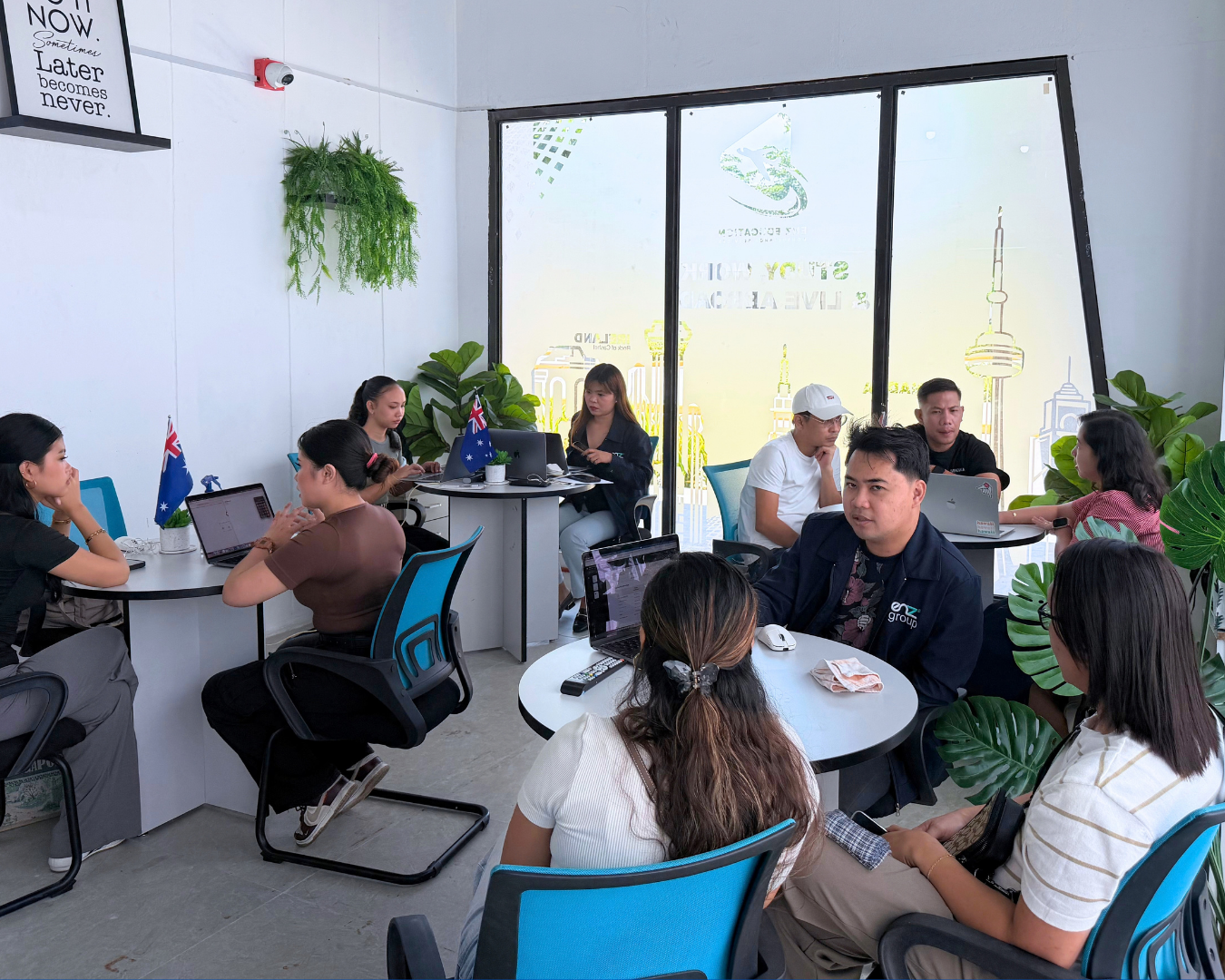
After 11 years of working with international students, I have learned that successful study-abroad journeys rarely begin at the airport.
They begin much earlier.
They begin when someone decides:
I want more from my career.
Not because there is no future in the Philippines.
Not because going abroad guarantees success.
But because professionals should be able to explore the full value of their education, skills, and ambitions—wherever those opportunities may exist.
If your degree and your current career no longer seem aligned, perhaps you don’t need to abandon everything you’ve built.
Perhaps you need to reposition it.
Your degree got you this far.
Now ask yourself how far it could still take you.
Are you a Nurse, Teacher, Engineer, Architect, Healthcare Professional, or another Filipino professional considering studying abroad?
Speak with an ENZ Education Consultancy Services Advisor and explore study options aligned with your education, professional experience and long-term career goals.
Don’t simply choose a country. Build a career strategy.


